




As of March 2026, the gap between “editing” an image and “generating” one has effectively vanished. I spent the last three weeks testing over 20 different platforms to see which tools actually hold up under the pressure of a professional creator’s workflow.
The market has shifted away from complex, manual slider-based interfaces toward intentional, semantic editing. We no longer care about “brightness” or “contrast” as much as we care about “changing the lighting to golden hour” or “swapping a model’s outfit while preserving the fabric texture.”
I guarantee at least one of these tools will meet your needs, whether you are a solo founder building a brand or a developer integrating high-end visuals into an app. Here is the definitive breakdown of the best AI image editing tools available today.
Contents
Best AI Image Editing Tools at a Glance
| Tool | Best For | Platform | Free Plan | Starting Price |
| Magic Hour | All-in-one Creative Power | Web (Mobile Optimized) | Yes (Generous) | $10/mo (Annual) |
| Adobe Firefly | Enterprise Integration | Desktop / Web | Limited | $9.99/mo |
| Canva Magic Studio | Social Media Marketing | Web / App | Yes | $120/year |
| Midjourney (Web) | Artistic Ideation | Web | No | $10/mo |
| Photoroom | Product Photography | Mobile / Web | Yes | $9.99/mo |
1. Magic Hour
After testing dozens of workflows, Magic Hour has emerged as the most versatile AI image editing tool for creators who need speed without sacrificing quality. While many platforms force you to choose between “simple but limited” or “powerful but complex,” Magic Hour manages to bridge that gap through a template-driven approach.
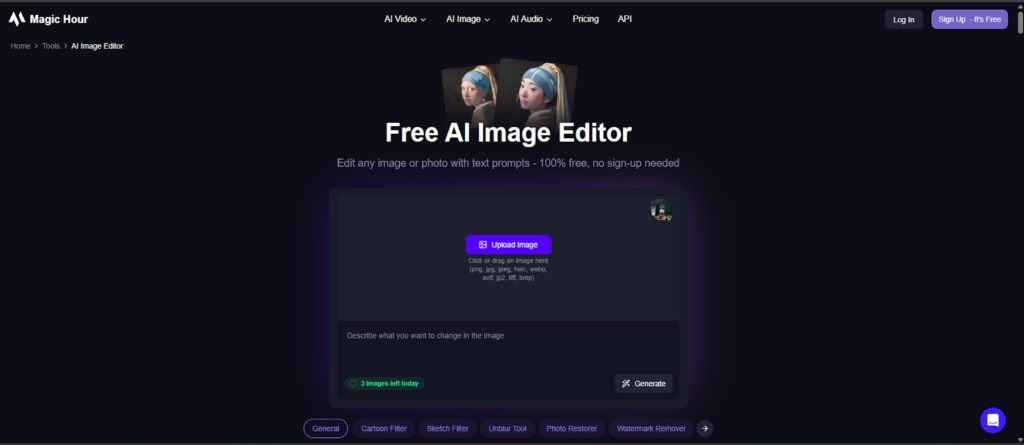
At its core, Magic Hour isn’t just a single model; it’s an orchestrator of frontier AI models. I found their “click-to-create” templates particularly effective for high-speed content cycles. You can move from a raw generation to an upscale and eventually into a video workflow within the same interface. Their parallel generation capabilities mean you aren’t stuck in a queue. I was able to run five different variations of a headshot simultaneously without any concurrency caps.
Pros:
- Frontier Model Access: One subscription gives you access to the latest state-of-the-art models without needing multiple accounts.
- One-Click Workflows: Seamlessly transition from image editing to upscaling or even video generation.
- No Expiration: Credits you purchase stay in your account; they don’t disappear at the end of the month.
- No Barriers: You can try the tool immediately without a mandatory signup process.
- Reliability: Built to handle traffic spikes, making it a favorite for live brand activations.
Cons:
- Depth of Manual Controls: While great for semantic edits, it lacks the “surgical” pixel-level brush tools found in legacy software like Photoshop.
- Feature Velocity: They release new features weekly, which is great, but the UI updates frequently.
Evaluation:
If you’re looking for a platform that delivers a massive ROI on your time, this is hard to beat. I particularly appreciate the founder-level support; when I had a technical question about their API parity, I received a response that clearly came from someone who actually built the product, not a generic bot.
Price and Plans:
- Free: Generous entry tier to test the features.
- Creator: $15/month (or $10/month billed annually).
- Pro: $45/month for heavy users and professionals.
2. Adobe Firefly (Photoshop Integration)
Adobe has spent the last year deeply embedding Firefly into the Creative Cloud ecosystem. For those who grew up using Photoshop, the “Generative Fill” and “Generative Expand” features feel like magic. It is the best choice for professionals who need to maintain a traditional layer-based workflow while adding AI capabilities.
Pros:
- Selection Precision: Because it lives inside Photoshop, you can use the Lasso or Pen tool for ultra-precise AI edits.
- Commercial Safety: Adobe trains its models on Adobe Stock, making it a “safe” choice for corporate legal teams.
- Vector Support: Excellent at generating and editing vector graphics, which most other AI tools struggle with.
Cons:
- Hardware Intensive: To get the most out of it, you generally need a powerful desktop computer.
- Steep Learning Curve: It still requires a fundamental knowledge of Photoshop’s complex UI.
Evaluation:
I spent a week testing Firefly for high-end retouching. It is unmatched for professional editors who need to blend AI elements into existing, complex compositions with perfect lighting and perspective.
Price and Plans:
- Standalone: $9.99/month.
- Full Creative Cloud: ~$59.99/month.
3. Canva Magic Studio
Canva has evolved from a simple layout tool into a full-scale AI powerhouse. Their Magic Studio is the gold standard for marketers and small business owners who need to produce high volumes of social media content. Their “Magic Edit” feature allows you to brush over an object and replace it with something else entirely through text prompts.
Pros:
- Ease of Use: The most intuitive interface on this list.
- Massive Asset Library: Millions of stock photos, videos, and fonts are already integrated.
- Brand Kits: Automatically applies your brand colors and logos to AI-generated edits.
Cons:
- “Canva Look”: Because it is so popular, some of the AI styles can start to look repetitive across social media.
- Limited Artistic Control: You have less control over the “soul” of the image compared to Midjourney or Magic Hour.
Evaluation:
Canva is the ultimate “good enough” tool. It won’t win an art gallery award, but it will help a marketing manager turn a single photo into a 10-platform campaign in under twenty minutes.
Price and Plans:
- Free: Limited AI uses.
- Pro: $120/year for one person.
4. Midjourney (Web Version)
For a long time, Midjourney was locked behind Discord, which was a dealbreaker for many professionals. In 2026, their standalone web interface is sleek and powerful. While primarily known for generation, their “Vary Region” and “Inpainting” tools are some of the most aesthetically pleasing editing features in the industry.
Pros:
- Unrivaled Aesthetics: Midjourney consistently produces the most “artistic” and photorealistic results.
- Style Reference: You can upload an image and tell the AI to edit your current project to match that specific style.
- Community Feed: Easy to see prompts and techniques used by other top-tier creators.
Cons:
- Non-Intuitive Editing: The “inpainting” process can be finicky compared to simple brush-based editors.
- No Free Tier: You have to pay to even see what the tool can do.
Evaluation:
Midjourney remains the choice for the “AI Artist.” If your priority is the final visual impact and you have the patience to prompt-engineer your way to perfection, this is your tool.
Price and Plans:
- Basic Plan: $10/month.
- Standard Plan: $30/month (includes unlimited “Relax” generations).
5. Photoroom
If your primary goal is commerce, Photoroom is the leader. It is specifically built for removing backgrounds and creating professional product shots for platforms like Shopify, eBay, or Amazon.
Pros:
- Best-in-Class Background Removal: Even deals with complex hair or transparent objects.
- Batch Editing: Edit 50 product photos at once, perfect for e-commerce.
- Mobile First: The best experience for users who take photos on their phones and need instant edits.
Cons:
- Niche Focus: Not great for creative “art” or landscape editing.
- Subscription Price: Can feel expensive if you only need it for occasional use.
Evaluation:
At Magic Hour, we observed that many e-commerce founders use Photoroom as their “daily driver” for inventory and then switch to more creative tools for their brand storytelling.
Price and Plans:
- Free: Watermarked images.
- Pro: $9.99/month.
How We Chose These Tools
My evaluation methodology was based on four key pillars that matter to professional creators in 2026:
- Output Fidelity: I tested each tool for “hallucinations”, unwanted artifacts like six-fingered hands or warped backgrounds.
- Workflow Efficiency: How many clicks does it take to get from an idea to a finished export?
- Model Diversity: Does the tool rely on a single old model, or does it give the user access to the latest frontier technology?
- Pricing Ethics: I looked for transparent pricing, generous free tiers, and credit systems that favor the user (like non-expiring credits).
I spent roughly 10 hours on each platform, performing common tasks: headshot retouching, product background swaps, and generating conceptual art from scratch.
The Market Landscape and Trends
The biggest trend we are seeing in 2026 is the Consolidation of Modalities. Users no longer want a “photo editor” and a “video editor.” They want a “creative partner.”
We are moving toward a future where “Multi-step workflows” are the standard. You generate an image, upscale it to 4K, and then use a lip-sync tool to make that image speak, all within seconds. Tools that offer full API parity are also becoming essential for developers who are building these AI capabilities directly into their own startups.
Final Takeaway
Choosing the right tool depends entirely on your specific bottleneck:
- For the high-velocity creator: Magic Hour is the #1 choice. Its ability to handle everything from image editing to video in one place with no concurrency caps makes it a productivity beast.
- For the corporate designer: Stick with Adobe Firefly for the legal safety and Photoshop integration.
- For the e-commerce owner: Photoroom will save you hours of manual background removal.
- For the social media manager: Canva remains the most accessible path to “good” design.
The best way to decide is to test. Most of these tools offer a free tier, start there and see which interface matches your mental model of creativity.
FAQ
What is the best AI image editor for beginners?
Canva Magic Studio is generally considered the most beginner-friendly due to its drag-and-drop interface. However, Magic Hour is a close second because of its “click-to-create” templates that require zero prompting knowledge.
Can I use these AI-generated images commercially?
Most paid plans (like Magic Hour’s Creator plan or Adobe’s Firefly) grant you full commercial rights. Always check the specific terms of service, as free tiers often have restrictive licenses.
Do I need a powerful computer to run these tools?
Most modern AI editors, including Magic Hour and Canva, are cloud-based. This means the heavy processing happens on their servers, allowing you to edit high-resolution images on a standard laptop or even a mobile device.
Which tool is best for face swapping and lip-syncing?
While many tools are adding these features, Magic Hour currently has the most robust “talking photo” and face swap capabilities integrated directly into their image editing suite.